


What did a medieval farm labourer earn?
2 pennies a day, when there is work.
About $510 a month in today's gold.
A month of that pay weighs about as much as a die in gold.
The plague killed half the workers, so your wage doubled. Parliament passed a law to cap it at once.
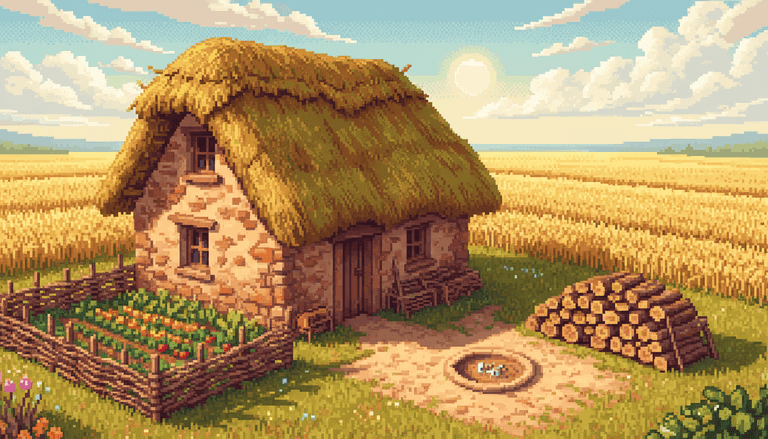
Where the money came from
A farm labourer was hired by the day for the jobs of the farming year: weeding, haymaking, mowing, reaping and threshing. Harvest took only six or eight weeks, and outside it such work was harder to find. After the Black Death the Statute of Labourers of 1351 tried to hold him to the old rates, with no food or drink on top: a penny a day for weeding or haymaking, 5 pence an acre for mowing, and for reaping 2 pence a day in the first week of August and 3 in the second. He had to carry his tools openly to the market town and be hired there in public. Twice a year he swore to keep the rules, and a man who refused went into the stocks for three days or more. At Yalding the Earl of Stafford paid his labourers a penny a day in 1348 and two by 1350, while other landowners nearby paid three, and John Giffard warned the earl that the serfs would leave for higher wages. In 1373 John Julian and two other Lincolnshire mowers were reported for taking 8 pence an acre instead of the lawful 5. Labourers spent two-thirds of what they earned on food and drink. Across England the average day labourer's wage almost doubled between 1349 and 1350, so the law failed: the labourer earned about twice the old rate.
Sources: umsl.edu · en.wikipedia.org · vincentdelabastita.github.io · themcs.org
What a farm labourer's pay bought in 1350
 a gallon of ale: less than a day's pay
 a day of a master mason: 4 days' pay
 a peasant's wool tunic: 4 weeks' pay
 a year at Oxford: 4 years' pay, more than a whole year of it
 a craftsman's townhouse: 6 years' pay, more than a whole year of it
Every price of 1350, with its source, is on the prices page.