


What did a medieval town labourer earn?
3 pennies a day.
About $760 a month in today's gold.
A month of that pay weighs about as much as 6 paperclips in gold.
You carry the stone; the mason gets the credit. The rate did not move for forty years.
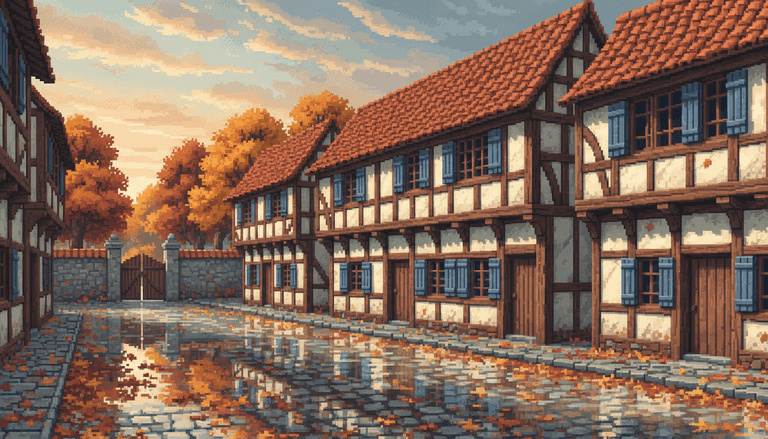
Where the money came from
A town labourer worked on a building site under a master mason or carpenter. He was the master's journeyman, with far more skill than a common labourer, and not an apprentice training to become a master himself. Work ran from sunrise to sunset: twelve or thirteen hours in summer, eight or nine in winter. In 1351 the Statute of Labourers capped a mason's servant at 1½ pence a day. Just before the Black Death the work paid 1½ pence; by the early 1360s it paid 3, twice as much, and it stayed at 3 until 1400. He was paid in money, and probably got little food, drink or clothing on top. Bad weather, or a late load of stone, brick or timber, could halt the work, so one historian counts only 210 paid days a year, or 630 pence. Rising prices ate much of the gain. Builders' real wages hit bottom in 1351–55 and passed their old peak only in 1376–80. In York, Lady Row was built on a churchyard after a grant of 1316, eleven bays long, and most of its homes had one room on each floor. Its rents paid for a priest's prayers in the church beside it. A master mason earned 5 pence a day in the same years, so the labourer got three-fifths of his master's pay.
Sources: mpra.ub.uni-muenchen.de · en.wikipedia.org · british-history.ac.uk
What a town labourer's pay bought in 1350
 a gallon of ale: less than a day's pay
 a day of a master mason: 3 days' pay
 a year's cottage rent: 4 weeks' pay
 a year at Oxford: 3 years' pay, more than a whole year of it
 a craftsman's townhouse: 4 years' pay, more than a whole year of it
Every price of 1350, with its source, is on the prices page.