


What did a medieval master mason earn?
6 pennies a day.
About $1,500 a month in today's gold.
A month of that pay weighs about as much as 3 dice in gold.
You build cathedrals. Oxford's colleges paid you exactly 6 pennies a day for 170 years.
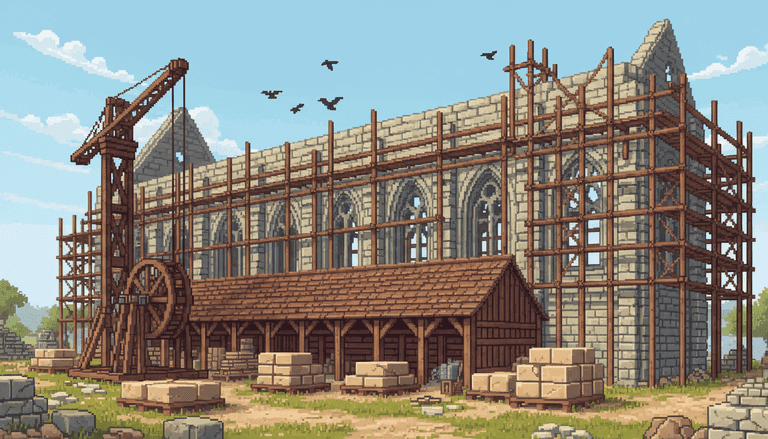
Where the money came from
A master mason was paid by the day and worked from sunrise to sunset: twelve or thirteen hours in summer, eight or nine in winter. Before the Black Death, where pay changed with the season, the winter wage was usually three quarters of the summer one; at Exeter Cathedral in 1306 masons got 5¼ pence a day in summer and 4½ in winter, because the days were shorter. In 1351 the Statute of Labourers tried to hold a master mason who worked fine stone to 4 pence a day from Easter to Michaelmas, and less for the rest of the year. It largely failed. Across southern England a master earned 5 pence a day from the 1360s to 1400, and 6 by about 1410; some Oxford colleges paid 6 pence from 1362 to 1536. Bad weather or a late load of stone, brick or timber could halt the work, and most masters worked for several employers, so none could count on steady work all year. Some made extra money as contractors, selling building materials to the job. The best rose far higher: William Wynford, master mason at Wells Cathedral and the designer of New College, Oxford, was granted a pension of £10 a year by Edward III in 1372. In the later 1300s a mason's skilled helper got 60 percent of his master's wage, so the master earned two thirds more than his helper.
Sources: mpra.ub.uni-muenchen.de · themcs.org · umsl.edu · en.wikipedia.org
What a master mason's pay bought in 1350
 a hen: less than a day's pay
 a longbow and 24 arrows: 6 days' pay
 a cow: 4 weeks' pay
 a year at Oxford: 16 months' pay, more than a whole year of it
 a craftsman's townhouse: 23 months' pay, more than a whole year of it
Every price of 1350, with its source, is on the prices page.