


What did a medieval spinster earn?
About 1¼ pennies a day, paid by the pound of wool.
About $320 a month in today's gold.
A month of that pay weighs about as much as 19 coffee beans in gold.
A pound of wool took more than a day. "Spinster" was a job long before it was an insult.
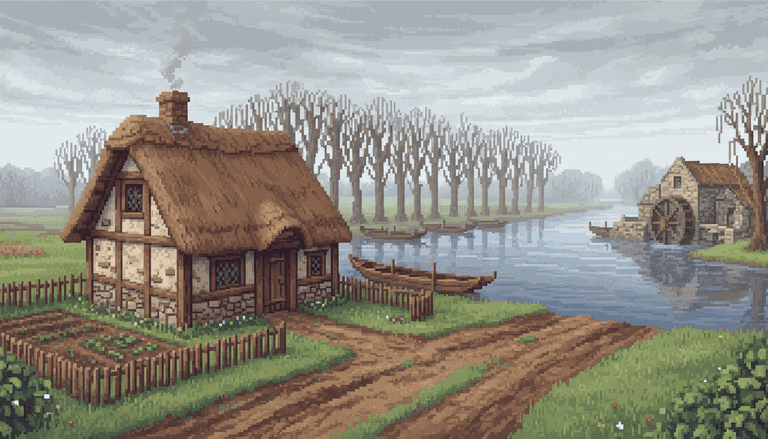
Where the money came from
A spinster turned raw wool into yarn, and the word first meant a woman whose work was to spin. In the countryside women carded, spun and wove, while combing the warp threads was harder work, often done by men. In 1300 the common cloth, worsted, was easily made in village homes, and most of it was: the wool was combed and spun with distaff and spindle, still in its natural oils, and woven by one person on a narrow loom. Much of the cloth made in 1300 was spun at home and brought in no money at all. Spinners, carders and weavers were paid by the piece, not by the day. At Laleham, a Thames village whose lord was Westminster Abbey, carding and spinning cost 2 pence a pound for weft yarn and 3 pence for warp in 1290. Around then a house was built on the abbey's farm there, with stables for cattle and sheep. Historians reckon combing, carding and spinning at 2 pence a day, and set a woman's day wage at half a man's, so a man earned twice as much. Men rarely spun, though: the work went on all year and was usually a second job. In the 14th century the spinning wheel came in for weft thread, and it made a spinner three times as quick at weft.
Sources: en.wikipedia.org · brewminate.com · british-history.ac.uk
What a spinster's pay bought in 1350
 a dozen eggs: less than a day's pay
 a day of a master mason: a week's pay
 a longbow and 24 arrows: a month's pay
 a year's food for one adult: 18 months' pay, more than a whole year of it
 a one-bay cottage: 18 months' pay, more than a whole year of it
Every price of 1350, with its source, is on the prices page.